

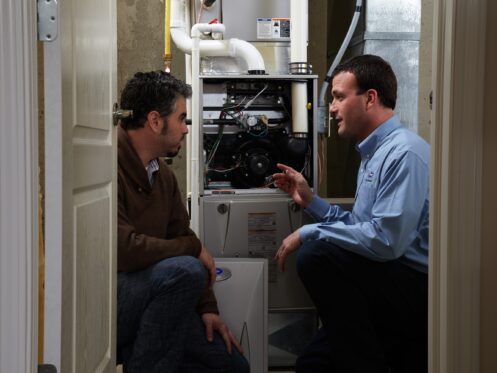
Heat recovery ventilation is a technique for significantly improving the efficiency of a heating system. Most heating methods with an exhaust system are compatible with a heat recovery ventilator (HRV), and many other designs can operate alongside an independent HRV. If you’re considering adding HRV to your system or for a new heating installation, you might wonder what it is and whether it’s worth the investment.
What Is an HRV?
The basic idea behind an HRV is to take the heat from the ventilated air leaving a house and use it to warm incoming air. Notably, an HRV doesn’t usually mix the airflows. Instead, a heat exchanger in the ventilation system routes the heat toward the air intake. As the incoming air flows across the heat exchanger, it warms up.
The goal of an HRV is to improve efficiency by limiting the amount of waste heat that leaves a house. After all, you paid to heat that air. You probably don’t want to pay to heat the outdoors.
The Heat Exchanger Core
Every variant of an HRV uses a heat exchanger core. This is where the heat transfer between the ventilated and incoming air happens. Normally, the heat exchanger core is a conductive metal, such as aluminum, or a durable plastic.
Notably, a heat exchanger core also allows the system to control the humidity level. An HRV only recovers heat. Consequently, the water vapor in the ventilated air still ends up outdoors.
HRV Mechanics
Airflow is the major mechanical issue with any HRV. To maximize efficiency, the ventilation and intake fans need to be fairly well balanced. This ensures the maximum level of contact between the heat exchanger and both the incoming and ventilated air. Consequently, HRV systems’ fans operate at notably slower speeds compared to typical HVAC fans. Models often run at between 50 and 200 cubic feet per minute.
The operating cost of an HRV tends to be fairly low because the fans are the only moving components. You can usually expect an HRV to require between 30 and 100 watts. The fans are out of the way and run quietly, so most household members will never notice them running.
Be aware that the ventilation system in an HRV runs continuously. The heat recovery process happens whether the heating system is running or not. This is because your house is losing heat continuously, too. Consequently, there is always air flowing into the ventilation system. To address this issue in the summer, an HRV includes a bypass system that exhausts all the heat when the temperature is higher. The bypass avoids passing ventilated warm air over the exchanger when it is undesirable.
Expected Efficiency of Recovery
A modern HRV recovers an impressive 60% to 85% of what would otherwise be wasted heat. This is after accounting for internal system losses from inherent inefficiencies in materials and heat exchange.
Note that you can only recover the percentage of heat loss that goes out through your HVAC’s ventilation system. In a typical home, the heat loss ranges from 15% to 30%. For an HRV that achieves 80% recovery efficiency, that would yield a total reduction in fuel costs of between 12% and 24% for your household.
HRV Efficiency Versus Heating System Efficiency
It is important to note the difference between HRV efficiency and heating system efficiency. Your heating system remains as efficient as it currently is. If it achieves a 90% rating in a particular fuel efficiency standard, an HRV will now improve its efficiency.
Instead, an HRV will reduce the amount of heat your system has to produce. Take the example with 80% recovery efficiency and a 24% reduction in household energy consumption. In that scenario, a 90% efficient system would need to run about 24% less of the time, thanks to the recovery of potentially lost heat.
Retrofitting
HRV systems are good candidates for retrofitting to forced-air furnaces and other designs that use ductwork. Our technicians can typically add a heat exchanger to the ductwork to connect the HRV. Virtually any system that uses a fuel-air mixture for heating can accommodate an HRV as long as the air intake path is accessible.
Notably, this makes retrofitting an HRV to a ductless HVAC system less appealing. It is possible to place the heat exchanger at a target location to provide some benefit without adding extensive ductwork. These systems generally use an HRV that’s independent from the heating supply system in the HVAC. You can use an HRV independently with systems like mini-splits, boilers, and heat pumps.
Should You Consider an HRV?
Areas with prolonged winters tend to enjoy the best savings from using an HRV, especially in places where the nighttime temperature routinely drops below 40 degrees Fahrenheit. Those temps are quite common in our part of Virginia during the winter and often in the spring and autumn, too. Consequently, we do recommend HRVs to a large number of customers in our service area.
Housing Ventilation Characteristics
HRVs work best with houses that already have fairly airtight designs. An HRV is a great way to bring in fresh air without cooling off your house, making it an excellent choice for maximizing efficiency. You can enjoy fresh air from the intake without significantly increasing your heating bills.
Indoor Air Quality
Using an HRV is a particularly good option if you have indoor air quality concerns. Warming incoming air makes it easier to add more fresh air. If someone in your household has respiratory issues, especially during the winter when your house is buttoned up, then you should consider an HRV.
Condensation Problems
An HRV can help you exhaust excess moisture from your home during the winter without losing heat. Moisture is a common problem in more airtight houses, especially in an environment like we have in Virginia, where it tends to be humid all year. Adding an HRV should reduce your home’s risk of mold growth by maintaining a lower indoor humidity level.
Davis & Green is the HVAC services provider for many people in Richmond, VA and the surrounding areas. We got our start in 1984, and our company has built a stellar reputation handling both residential and commercial work. Our technicians would be happy to perform installations, repairs, upgrades, and maintenance on your HVAC. We are a Lennox Premier Dealer and can work on HVAC models from other brands.
You are welcome to take advantage of our 24/7 emergency availability to deal with any HVAC needs. We also offer financing on approved credit for many types of HVAC installation jobs.
The BBB gives us an A+ rating. People also respect our company because we work with non-profit organizations like the Special Olympics of Virginia and The Doorways. Check out our customers’ amazing reviews of our business online on sites like Yelp, Facebook, and Google.
If you believe your Richmond home or business would benefit from HRV technology, contact Davis & Green today to discuss your options.